
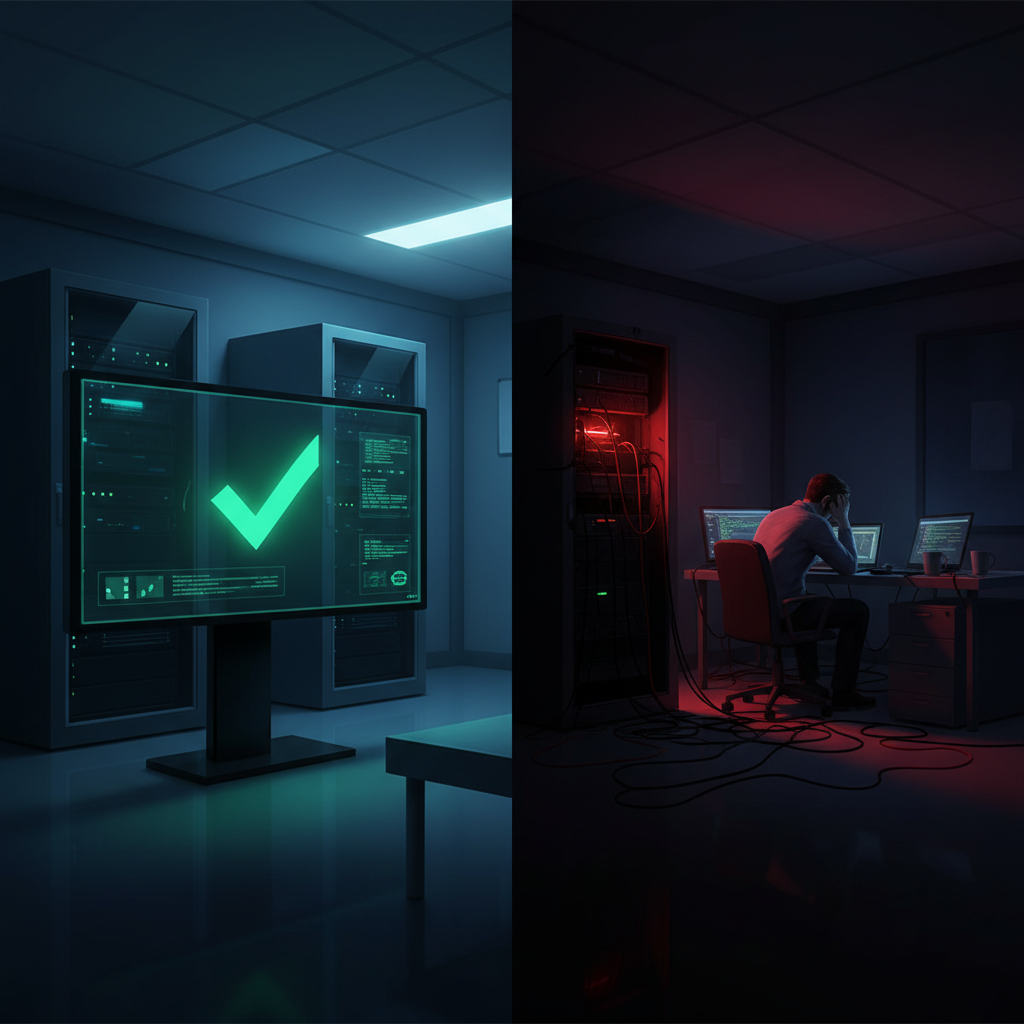
Your Backups Are Green. Your Business Would Still Go Dark.
Somewhere in your infrastructure, a backup job completed successfully last night. The dashboard shows a green checkmark. Your IT admin breathed a small sigh of relief. And if ransomware hit your network tomorrow morning, there's a reasonable chance you still couldn't recover in time to matter.
That's not a hypothetical. It's what a viral post in the cybersecurity community laid bare when one IT team finally tested their disaster recovery plan after two years — and discovered that while backups reported success, the actual restores had been silently failing for months. Their runbooks referenced servers that had been decommissioned. Their promised four-hour RTO? Nine hours in reality.
This is the gap that breaks small businesses.
Backup and Disaster Recovery Are Not the Same Thing
This is the most expensive misconception in small business IT. A backup is a copy of your data. Disaster recovery is the plan, process, and tested capability to restore that data and resume operations within an acceptable timeframe.
You can have one without the other. Most small businesses do.
Here's what that looks like in practice:
- Backup without DR: You have copies of your files. But no documented restore procedure, no tested RTO, no priority order for which systems come back first, and no one who has actually run through the process under pressure.
- DR without current backups: You have a plan, but the data it would restore is weeks old. You recover — into the past.
- Neither tested: You have both on paper. Neither has been validated. You find out what works on the worst day of your professional life.
What It Looks Like at Scale — And Why Small Businesses Aren't Immune
Hasbro recently disclosed unauthorized access to its systems in an 8-K SEC filing, activated business continuity plans, and took systems offline. According to Security News, remediation was expected to take weeks — not the hours most DR plans promise. A company with enterprise-grade resources and documented continuity plans still faced a multi-week operational disruption.
If that's the reality for a global brand, consider what an untested recovery plan means for a 20-person Ohio manufacturer or a government contractor processing CUI.
The Hasbro incident is a direct, real-world illustration of what the Reddit community already knows: the distance between "we have a plan" and "we can actually execute that plan under fire" is measured in days of downtime and hundreds of thousands of dollars.
And hospitals are learning the same lesson. According to Security News, a chief medical information officer emphasized that rehearsals — not the existence of backups — are the critical differentiator between a short outage and a prolonged one. The article makes clear that organizations that run tabletop exercises and live recovery drills recover faster. Those that don't, don't.
The lesson isn't unique to healthcare. It applies to any organization where downtime has a cost.
The Three Places Small Business DR Plans Fail
1. Untested restores Backup software reports success based on whether data was written, not whether it can be read back. Corrupted backups, permission errors, and version incompatibilities don't show up as failures in most dashboards. If you haven't done a full restore to a clean environment in the last 90 days, you don't actually know if your backup works.
2. Stale runbooks A runbook that references a server you decommissioned 18 months ago isn't a recovery document — it's a liability. DR documentation decays faster than most teams update it. Every infrastructure change, every cloud migration, every new SaaS tool added to your stack is a potential gap in your recovery playbook.
3. Optimistic RTO assumptions RTO (Recovery Time Objective) is how long you plan to be down. It's usually set during a calm planning session, not stress-tested under real conditions. The Reddit scenario — four hours promised, nine hours actual — is not an outlier. It's the norm for untested plans. For a small business, nine hours of downtime can mean missed payroll, failed deliveries, and breach-of-contract exposure.
What This Means for CMMC and Ohio SB 220
If you're a government contractor working toward CMMC Level 1 compliance, backup and recovery aren't optional considerations — they're embedded in the practices around protecting covered data. An untested backup strategy isn't just a business risk; it's a compliance gap that auditors will find.
For Ohio businesses, SB 220 offers safe harbor from certain data breach liability — but only if you can demonstrate that reasonable cybersecurity controls were in place and functioning. A backup solution that silently fails restores is a control that exists on paper but not in practice. That distinction matters in litigation.
We've covered how the FTC Safeguards Rule requires continuous monitoring for businesses handling financial data — and the same principle applies here. A point-in-time backup check is not continuous assurance. Your recovery capability needs to be validated on a schedule, not assumed.
What an Actual DR Validation Looks Like
You don't need a massive budget to close this gap. You need a process:
- Test a full restore quarterly — to a clean, isolated environment, not over your production data. Confirm the data is readable and complete.
- Measure your actual RTO — run a timed drill. Document the real number, not the aspirational one.
- Audit your runbooks against current infrastructure — every server, every service, every credential referenced should exist and be accessible today.
- Define your RPO honestly — how much data loss is actually acceptable? If your backups run nightly but your RPO is two hours, you have a gap.
- Assign ownership — someone specific is responsible for DR validation. Not "IT." A named person with a calendar reminder.
As we explored in our breakdown of ransomware vs. wiper attacks for small businesses, the recovery path after a destructive attack depends entirely on whether your DR plan has been validated before the incident — not after.
The Green Checkmark Is Not a Recovery Plan
The Reddit post that sparked this conversation wasn't a cautionary tale about incompetent IT teams. It was a story about a competent team that trusted their tools without verifying their outcomes. That's a process failure, not a skills failure — and it happens everywhere.
The businesses that recover from ransomware in hours are the ones that practiced. The ones that are down for weeks are the ones that assumed.
Don't assume.
Take Action
A failed restore you discover during a ransomware attack is infinitely more expensive than one you find during a quarterly drill. The same principle applies to your broader security posture: the vulnerabilities attackers find first are the ones you never looked for.
Oscar Six Security's Radar gives small businesses and IT admins an affordable way to identify security gaps before they become incidents — at just $99 per scan. It's proactive visibility that doesn't require an enterprise budget.
If your DR plan hasn't been tested recently, your backup logs are showing green, and you're not sure what your actual RTO is — that's exactly where Radar fits in.
Focus Forward. We've Got Your Six.