
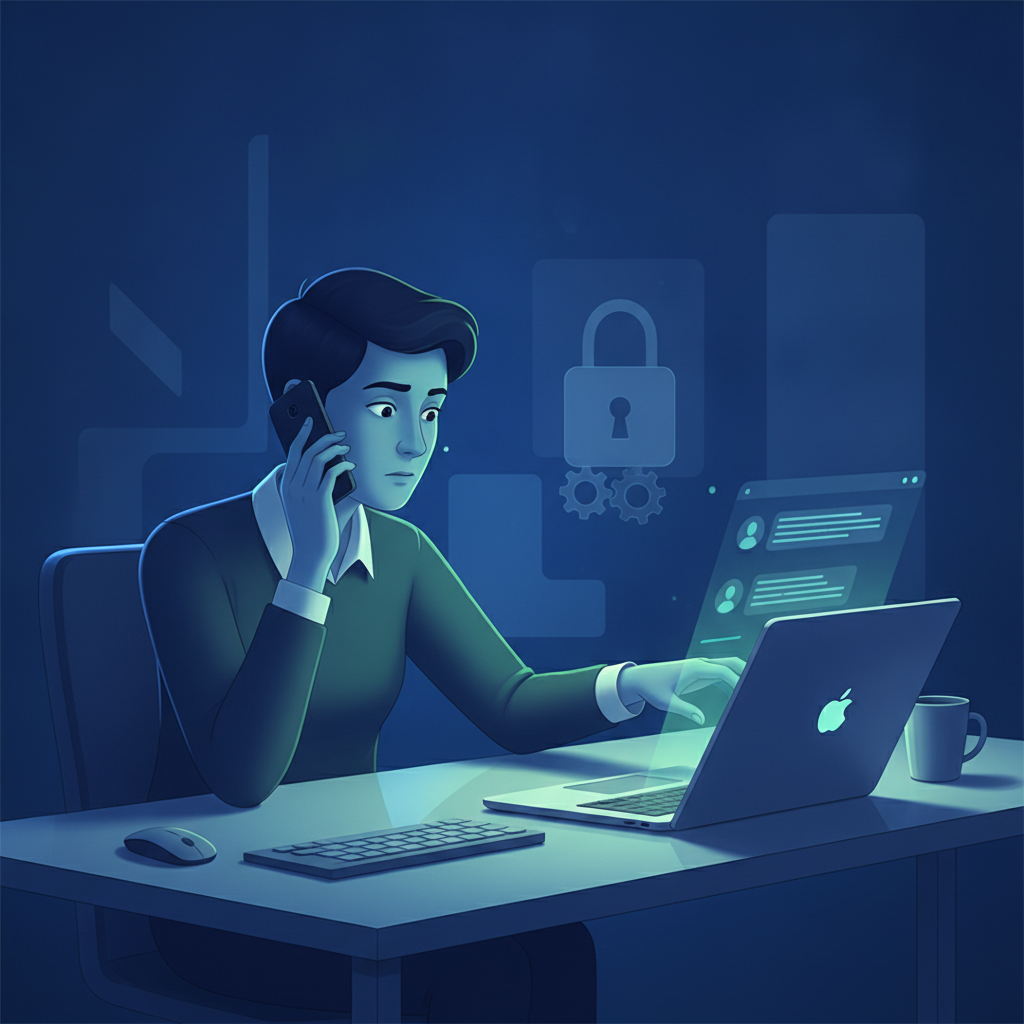
Picture this: an employee gets a chat message or phone call from someone who sounds exactly like IT. They know the company's software stack. They reference a real ticket number. They ask for a quick remote session to "fix an update issue." Thirty seconds later, they have full access to the machine — no malware download, no exploited CVE, no phishing link clicked. Just a conversation.
This is helpdesk impersonation, and it has quietly become one of the most effective ways attackers breach small businesses. A recent surge in reports — including a widely discussed thread asking "How are you protecting your clients from helpdesk impersonation attacks?" — points to the same uncomfortable truth: the weakest link isn't a server or a firewall. It's the trust employees place in anyone who sounds like IT.
The Attack Has Graduated From Theory to a 15-Minute Playbook
This isn't a hypothetical anymore. According to Security News, attackers are now abusing Microsoft Teams external chat to impersonate internal support contacts and deliver malware in under 15 minutes of first contact — a campaign with a confirmed Black Basta ransomware gang connection. That's faster than most IT departments can even confirm whether a ticket is legitimate, let alone respond to one.
And the trust exploitation doesn't stop at chat. According to The Hacker News, the Skyw4lker device code phishing campaign is abusing legitimate cloud login workflows to hijack accounts without a traditional exploit — the same principle as helpdesk impersonation: make the request look routine enough that no one questions it. We broke down this exact mechanic in our post on device code phishing and MFA bypass in Microsoft 365.
Perhaps most alarming is the nation-state dimension. According to Schneier on Security, researchers have been actively studying fraudulent North Korean IT workers who infiltrate organizations by posing as legitimate remote employees or contractors — proving that "someone who sounds like IT" isn't a fringe scenario dreamed up in a training video. It's a documented, resourced attack surface that ranges from a single phone call to a long-term infiltration scheme.
Why Small Businesses Are Especially Exposed
Small organizations often have:
- A lean IT function — one admin or an MSP, so employees aren't always sure who "real IT" is supposed to be.
- Informal verification habits — no standard process to confirm a caller's identity before granting access.
- Widely deployed RMM tools — meaning a convincing impersonator can talk an employee into installing a remote access tool that looks identical to the legitimate one already on their machine.
That last point is critical. We've covered how attackers exploit this exact gap in our guide to detecting unauthorized or rogue RMM agents — once a fraudulent remote tool is installed with employee-granted permission, it often bypasses the suspicion that an unapproved install would normally trigger.
A Concrete Playbook, Not Just Awareness
Telling employees to "be careful" isn't a strategy. Give them a script instead:
- Never grant remote access based on an inbound call, chat, or message alone. Legitimate IT requests should be verifiable through a second channel — a known ticketing system, a callback to a listed internal extension, or a pre-established Teams channel.
- Establish a verification phrase or ticket-lookup habit. If someone claims to be IT, employees should be trained to say: "Let me verify this through our ticket system and call you back." No real IT request should be derailed by that statement.
- Treat urgency as a red flag, not a reason to comply. Attackers manufacture time pressure because it short-circuits verification.
- Lock down who can approve new remote-access software. Pair this with the access-control principles in our post on who should own admin credentials in a small business.
- Extend verification to in-person and contractor scenarios, too. Our guide on identifying fake IT workers through in-person identity verification covers the on-site equivalent of this same threat.
- Run a tabletop exercise. Simulate a helpdesk impersonation call or chat and see how employees actually respond — not how you assume they would.
Verification Beats Training Alone
Security awareness training matters, but it fades. What doesn't fade is a hard rule: no remote access, credential reset, or software install happens without independent verification through a channel the attacker doesn't control. Build that rule into your onboarding, your IT documentation, and your incident response plan, and a convincing voice on the phone stops being enough to compromise your business.
Take Action
Helpdesk impersonation attacks succeed because they exploit trust, not technical gaps — which means your defenses need to be checked just as rigorously as your network. Regular proactive scanning helps catch the technical footholds (unauthorized remote access tools, exposed credentials, misconfigured permissions) that these social engineering attacks rely on once they get a foot in the door. Oscar Six Security's Radar scan is an affordable way to check your exposure for just $99 — no long-term contract required. See our solutions and get a clear picture of where you stand.
Focus Forward. We've Got Your Six.